
7 Capacitor Bank Replacement Signs to Check Today
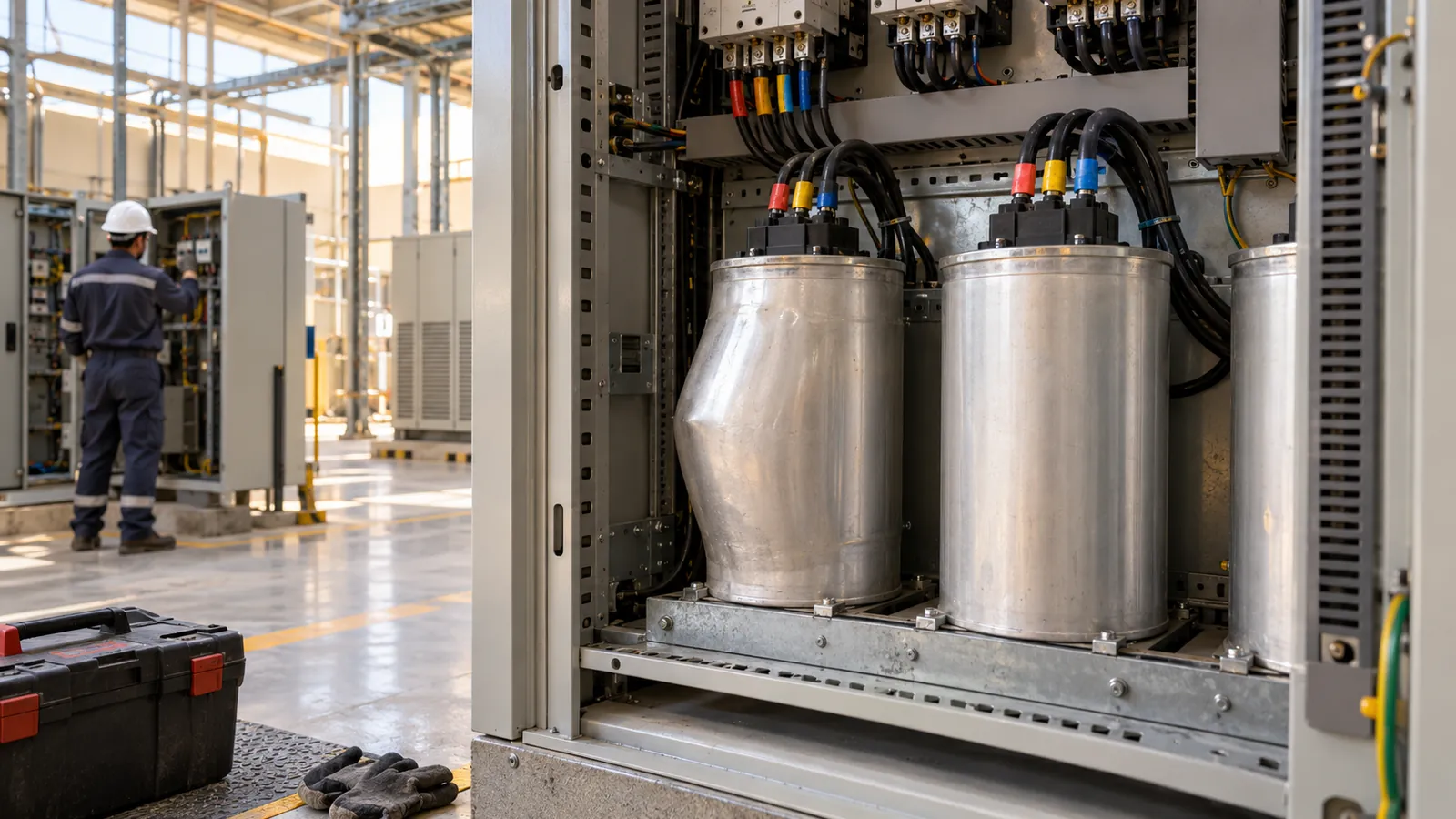
The clearest capacitor bank replacement signs are bulging or leaking cans, capacitance more than about 10% below the nameplate value, repeatedly blown fuses, hot terminals, steps that no longer switch, a power factor that will not reach target, and unusual noise. One confirmed sign on a step justifies testing the whole bank.
What you receive: if you send photos and the nameplate data of your bank, a written proposal with the replacement scope, ratings and price within one working day. Request a quotation
By Eng. Ahmed Ali, Saudi Power Factor Company. Published 9 October 2026.
What are the capacitor bank replacement signs?
Use this checklist during a routine walk-round. Isolate and discharge the bank before you open the door or touch any component.
| # | Sign | What to look for | Action |
|---|---|---|---|
| 1 | Bulging cans | Swollen top or sides, pressure device extended | Replace the unit now |
| 2 | Leaks or staining | Oil or residue on the can or the floor of the panel | Replace the unit |
| 3 | Capacitance loss | Measured value more than about 10% below nameplate | Replace the unit or the step |
| 4 | Repeated fuse failure | Same step blowing more than once | Test the capacitor, contactor and harmonics |
| 5 | Heat | Discoloured terminals or cables, warm contactors | Thermographic survey, then repair |
| 6 | Steps not switching or low power factor | Controller shows steps on but the power factor will not reach target | Check capacitors, contactors, CT and settings |
| 7 | Noise and vibration | Buzzing reactors, humming cans | Check harmonic levels and loose connections |
Treat the first two as urgent safety items. A bulged can has activated its internal protection or is about to rupture.
How do you test for capacitance loss?
Capacitors lose capacitance as they age, and heat and harmonics speed the process. Measure each unit with an LCR meter or a capacitance-measuring clamp with the bank isolated and discharged, then compare the result with the nameplate value. A drop beyond about 10% is a common replacement point, although the exact figure is the manufacturer's end-of-life limit.
Worked example: a 50 kVAr step
This is an example to show the method. The step is rated 50 kVAr at 440 V, 60 Hz, connected in delta.
| Line | Calculation | Result |
|---|---|---|
| Rated capacitance per phase | 50,000 ÷ (3 × 440² × 2π × 60) | about 228 µF |
| Measured capacitance per phase | LCR meter reading | 205 µF |
| Loss | (228 − 205) ÷ 228 | about 10% |
| kVAr the step now delivers | 50 × 205 ÷ 228 | about 45 kVAr |
A 10% loss means the step provides only 45 kVAr, so the bank under-delivers and the power factor drifts down. Several steps in this condition push the plant back into a penalty, which is how a capacitor problem first shows up on the bill. Replace the step, or all steps of the same age and type, because aged capacitors tend to fail together.
Why do the other signs matter?
Each sign points to a cause. Knowing it keeps the replacement from failing again.
- Bulging and leaks come from internal overheating, overvoltage or harmonic overload. Replacing the can without finding the cause repeats the failure.
- Blown fuses come from a shorted capacitor, an inrush from switching without damping, or harmonic currents above the rated 1.3 times the capacitor current allowed by IEC 60831.
- Hot terminals come from loose lugs, undersized cables or contactors that have worn contacts. A thermal image of the panel under load finds them in minutes.
- Dead steps and a low power factor come from failed contactors, a controller that has lost its CT signal or an incorrect target setting. These are repair jobs, not always capacitor replacements.
- Noise from reactors points to harmonic loading; humming cans can point to a failing dielectric.
For a full diagnosis of heat and failures, follow the steps on our page about capacitor bank overheating and failure.
When should the whole bank be replaced?
Replace the whole bank, not a single unit, in these cases:
- More than one step shows bulging or capacitance loss.
- The bank is older than the manufacturer's rated life, which is shorter in the heat of a Saudi panel room.
- The plant has added drives or UPS units since the bank was installed and the bank has no reactors.
- The controller, contactors and fuses are obsolete and spares are hard to find.
- Repeat failures continue after the cause has been fixed.
In these cases a full retrofit usually costs less over the next few years than repeated call-outs. Our capacitor replacement and PFC retrofit service audits the old panel and replaces only what has to change. New units are specified from the LV power capacitors range, and a maintenance contract keeps these checks on a schedule. Saudi Power Factor Company has worked in Saudi Arabia since 2010 and is approved by Saudi Aramco, SABIC and the Royal Commission for Jubail and Yanbu.
Capacitor bank replacement questions
How long does a capacitor bank last?
Life depends on the capacitor class, the operating temperature, the voltage and the harmonic level. Manufacturers state a design life in hours, and heat and harmonics reduce it. A bank in a hot panel room with drives on the same supply ages faster than one in a cool, clean installation.
Why are my capacitors bulging?
Bulging means gas has formed inside the can from internal heating, overvoltage or harmonic overload, and the pressure device has begun to operate. The unit is at the end of its life. Replace it, then check the voltage, the temperature and whether harmonics are present before the new unit is fitted.
Can I replace only the failed capacitor?
Yes, if the rest of the bank tests within limits and the failed unit is isolated. A single new unit among aged ones carries more of the load, so we usually recommend replacing the whole step. Send the nameplate data and test readings and we will advise.
How much does capacitor replacement cost?
The cost depends on the number of steps, the kVAr and voltage rating, whether reactors are needed, and the condition of the contactors and controller. Replacing capacitors alone costs far less than a new panel. Send photos and nameplate data and the proposal itemises the options.
How long does a replacement take?
Most of the time goes on specifying the correct units and procuring them. The work on site depends on the number of steps and the shutdown window you can offer. Our typical lead time is the next working day for parts in Dammam stock, and we plan the outage with your maintenance team.
Seeing capacitor bank replacement signs in your panel? Send us photos of the bank and its nameplate data and get a quotation within one working day.
Email: inquiry@saudipowerfactor.com | Request a quotation