
Power Factor Penalty Removal in Saudi Arabia
Saudi Power Factor Company removes the power factor penalty from industrial and commercial electricity bills in Saudi Arabia. We read your bill, size the capacitor equipment, build the panel in Dammam and commission it on site, so your plant holds the utility's target power factor month after month.
What you receive: a written proposal with the kVAr to install, the panel type, standard, lead time and price within one working day of receiving one month of your electricity bill. Request a quotation
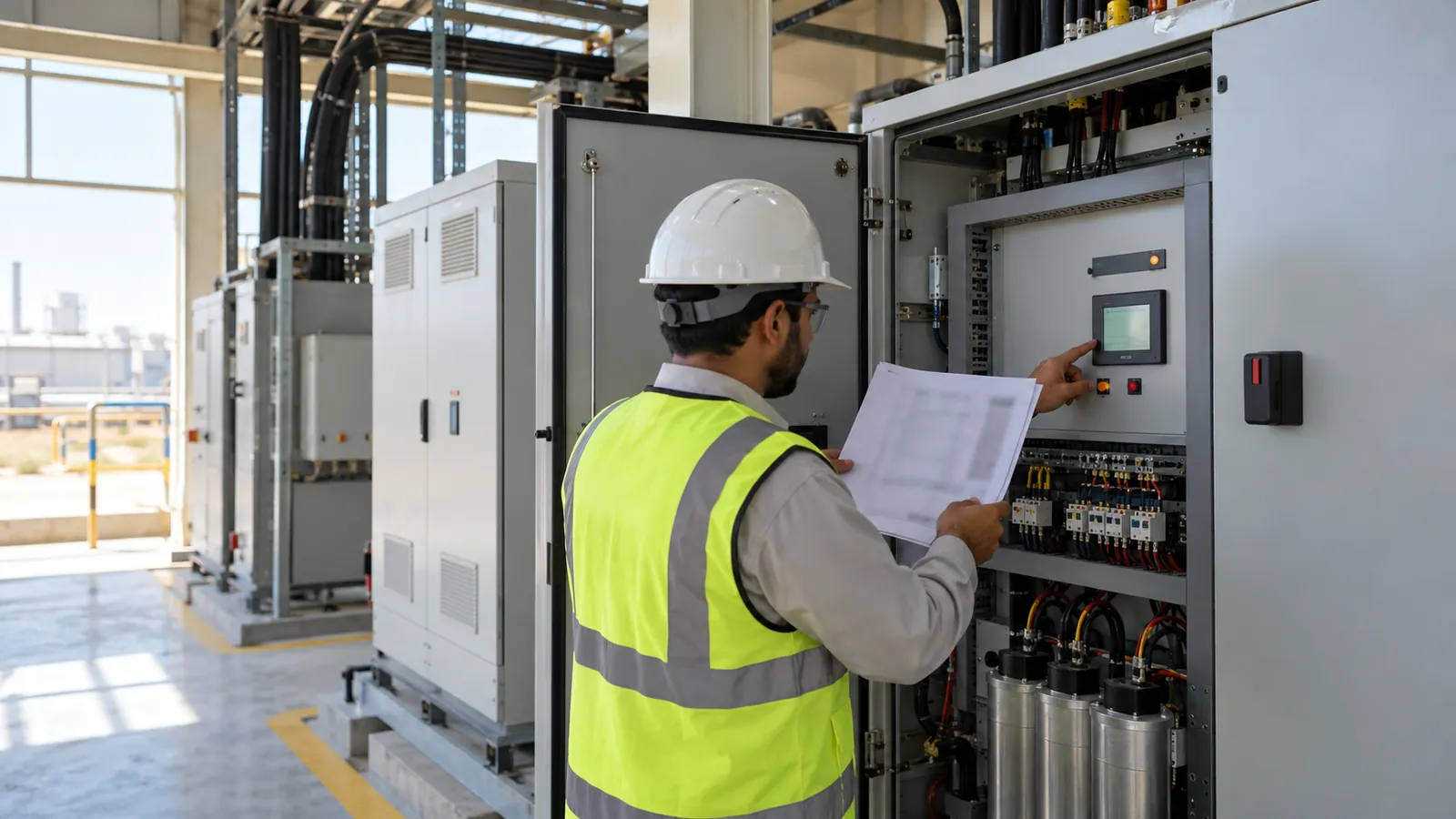
What is a power factor penalty?
It is an extra charge that the utility adds when your plant draws too much reactive power compared with the real power it uses. Power factor is the ratio of the two. A plant full of motors, compressors and chillers runs at a low power factor unless capacitors supply the reactive power locally.
In Saudi Arabia the utility's tariff sets the threshold and the billing basis. The bill may show a monthly power factor, a reactive-energy line in kVArh, or an adjustment to the demand charge. Under the Saudi Electricity Company tariff, customers above 1 MVA contract load must keep at least 0.90, and reactive energy above 48.4% of active energy in the month is charged at 5 halalas per kVArh. Our design target is 0.95, which stays clear of the 0.90 limit and the planned 0.95 minimum. The cause is the same in every case, and so is the remedy.
How is the charge worked out from my bill?
Look for three figures on your bill: the maximum demand in kW, the energy in kWh and the reactive energy in kVArh or the recorded power factor. The ratio of kVArh to kWh shows how far you are from unity. The utility then applies its charge when that ratio, or the power factor behind it, crosses the threshold.
We read the same figures to set the correction target. A worked calculation with sample numbers is available on our blog, and the sizing method is covered in PFC panel design and sizing.
Power factor penalty removal in Saudi Arabia: what we deliver
| Item | Range / specification | Standard | Typical lead time |
|---|---|---|---|
| Bill review | One month of billing, or a year if you have it; kVAr target set | Utility tariff basis | Within one working day |
| Capacitor sizing | kVAr and step layout to reach the target without over-correction | Engineering calculation | within one working day |
| Automatic correction panel | To project specification (25–1,200 kVAr per panel) | IEC 61439-1/-2 | 2–3 weeks |
| Detuned version | Reactors added where drives or UPS units create harmonics | IEC 61921 | 3–4 weeks |
| Controller and metering | Multi-step controller with power factor display and alarms | Manufacturer type-tested | included in the panel build |
| Commissioning and proof | Target set, switching confirmed under load, before and after readings recorded | Site test record | Included in project |
We build with ABB, Schneider Electric and Siemens components, and our Italian technology partner Elcontrol Energy Net supplies controllers and power quality analysers.
How do I avoid a penalty for good?
Four steps keep the charge off your bill:
- Measure. Establish the true power factor and demand, with a power quality survey if the load swings widely.
- Size. Pick the kVAr from demand and target, with a margin for load growth.
- Install. Fit an automatic APFC panel at the incomer, or capacitor stages at large motors.
- Maintain. Capacitors age. A yearly check of capacitance, contactors and the controller keeps the correction in place.
If your supply carries variable frequency drives, specify reactors so the capacitors survive. Many sites that recorded a penalty after installing a bank had a failing or incorrectly set controller, not too little capacity.
Is a 0.98 power factor good, and what target should I set?
A power factor of 0.98 is excellent. It means almost all the current you draw is doing useful work. Most plants aim for 0.95 or higher, which leaves a margin above the utility threshold when the load drifts. Going all the way to 1.00 is rarely worth the cost and risks over-correction at low load.
We set the controller target with a safety margin over the SEC figure, so a poor month does not trigger the charge. If your bill already shows a penalty and you want to know why it happened, see our guide to low power factor charges on the electricity bill.
How do we remove the penalty step by step?
- Bill received. You send one month of your bill, or a load list for a new site.
- Target and sizing. We set the correction target and calculate the kVAr, then confirm whether reactors are needed.
- Proposal. You receive scope, drawings, lead time and price within one working day.
- Build. The panel is assembled in our Dammam workshops.
- Factory test. We test wiring, protection and step switching and issue a record.
- Installation and commissioning. We deliver, set the controller and prove the power factor under load.
- Follow-up. After the next billing cycle, send us the new bill and we confirm the result with you.
- Support. Spares and maintenance remain available.
Saudi Power Factor Company has worked in Saudi Arabia since 2010 and is approved by Saudi Aramco, SABIC and the Royal Commission for Jubail and Yanbu. Projects for all three are behind us, and our management systems are certified to ISO 9001, ISO 14001 and ISO 45001. We deliver to every region of Saudi Arabia.
We have worked on projects for Saudi Aramco, SABIC and the Royal Commission for Jubail and Yanbu, in all regions of Saudi Arabia. Tell us your plant type and city in the quotation form, and we describe the scope closest to your penalty-removal projects written as content: plant type, location, power factor before and after, kVAr installed job.
Penalty removal applies to every tariff-metered site with motor loads, from factories and cold stores to hospitals and malls. Jubail is about 1 hour from Dammam and Riyadh about 4 hours by road; Jeddah and Yanbu are reached by air or road. Read about our complete power factor correction services.
Penalty removal questions
Who provides power factor penalty removal in Saudi Arabia?
Saudi Power Factor Company provides penalty removal across Saudi Arabia, from bill review to panel supply and commissioning, built with ABB, Schneider Electric and Siemens components. We are approved by Saudi Aramco, SABIC and the Royal Commission.
What affects the cost of removing the penalty?
Cost follows the kVAr required, the number of steps, the need for reactors, the enclosure and IP rating, and the controller and switchgear make. Your bill sets the kVAr, so the proposal prices a panel matched to your tariff, and payback is judged against the monthly charge you pay now.
How long does it take to remove the penalty?
The schedule has three parts: proposal and drawing approval, workshop build, and installation with commissioning. Our typical lead time is 2–3 weeks for an APFC panel and 3–4 weeks for a detuned bank. The charge disappears from the first bill issued after the panel holds the target power factor.
How can I check the penalty on my bill?
Compare the recorded power factor, or the ratio of kVArh to kWh, against the threshold for your tariff. If the figure is below it and a reactive or power factor line appears on the bill, send us the bill and we confirm the cause and the fix.
Can you support our consultant's study?
Yes. We review your consultant's load study and single-line diagram, issue a compliance statement with any alternatives, and submit drawings for approval. Our survey data can also support the study where you need measured figures.
Paying a power factor penalty in Saudi Arabia? Email us a single month of your electricity bill, and our quotation reaches you within one working day.
Email: inquiry@saudipowerfactor.com | Request a quotation