
Power Factor Correction in Saudi Arabia
Saudi Power Factor Company provides power factor correction in Saudi Arabia for industrial plants, commercial buildings and EPC contractors: APFC panels, capacitor banks, detuned and harmonic filters, power quality surveys and maintenance. We size the correction from your electricity bill or load list, build it in Dammam and commission it on site. Typical lead time: 2–3 weeks for an APFC panel and 3–4 weeks for a detuned bank.
What you receive: a written proposal with the kVAr rating, equipment type, standard, lead time and price within one working day of receiving your bill or load list. Request a quotation
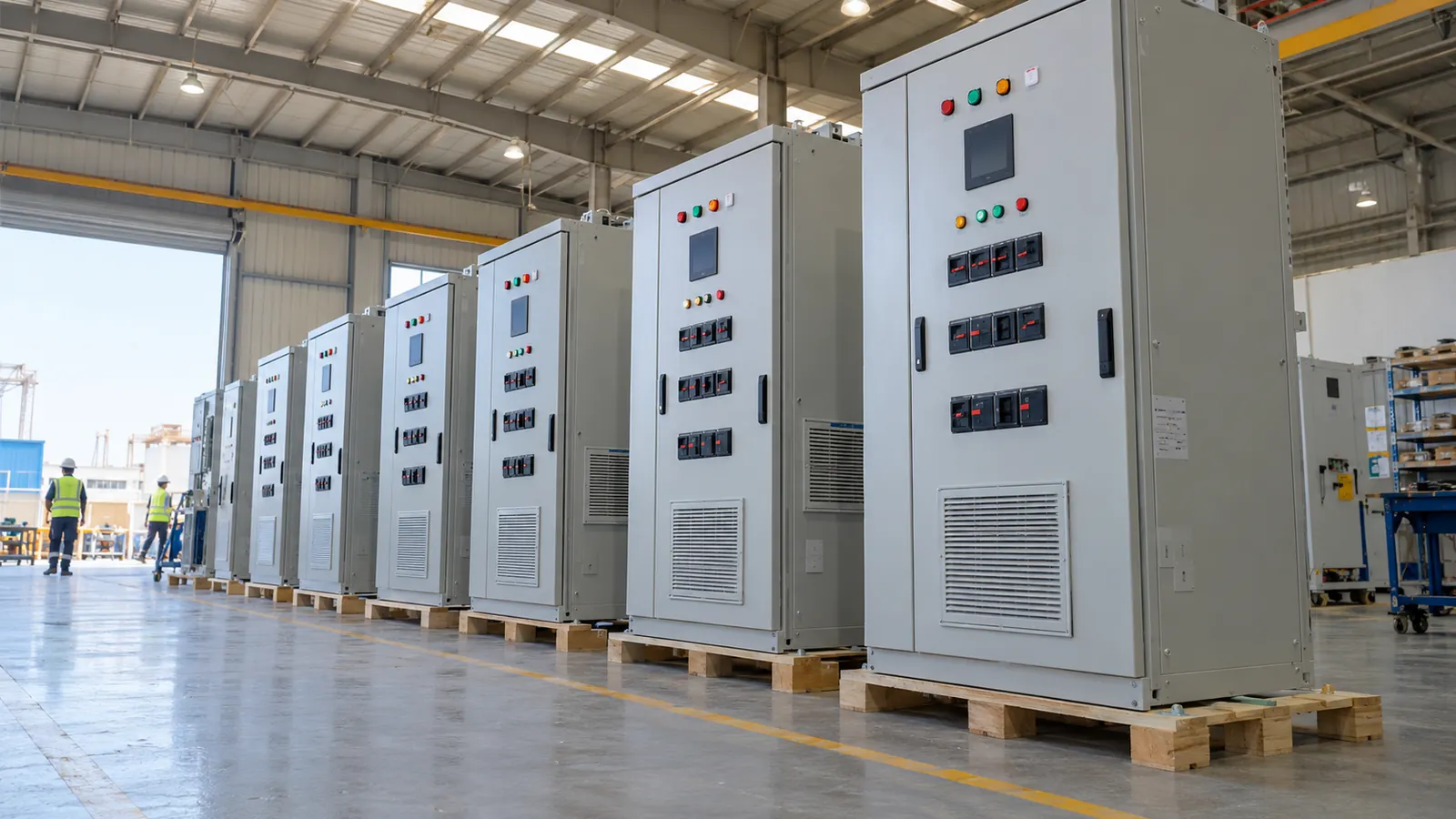
What is power factor correction and what does it save?
Power factor is the ratio of useful power (kW) to the total power your supply delivers (kVA). Motors, transformers, chillers and welding sets also draw reactive power, which does no useful work but still loads your cables, switchgear and transformer. A plant with a power factor of 0.75 draws noticeably more current than a plant at 0.95 for the same kW.
Power factor correction adds capacitors close to the load so the reactive power is supplied locally instead of from the grid. The result is lower current, less voltage drop and less heat in cables and transformers. Where your tariff applies a power factor charge, correction removes that charge from the bill. It also releases capacity on an existing transformer, which can defer the cost of an upgrade.
Low power factor usually has a familiar set of causes:
- induction motors running well below their rated load, which is common on pumps, fans and conveyors;
- lightly loaded transformers, whose magnetising current stays constant whatever the load;
- chillers, compressors and lifts that start and stop all day;
- welding sets, furnaces and presses with high, fluctuating reactive demand; and
- large buildings where cooling and ventilation motors run for long hours.
Correction does not reduce the kWh your equipment consumes. The saving comes from penalties avoided, losses reduced and capacity released. Utility tariff rules are set by SEC; we size the correction to the target your bill shows. Under the Saudi Electricity Company tariff: 0.90 is the minimum above 1 MVA contract load; we design to 0.95.
Power factor correction in Saudi Arabia: our services
The table lists what we supply, the standard each item is built to and where to read more. Ranges follow the project specification: APFC panels 25–1,200 kVAr, detuned banks 50–1,000 kVAr, fixed banks 5–300 kVAr, thyristor PFC 50–800 kVAr and MV banks 300–10,000 kVAr.
| Item | Range / specification | Standard | Typical lead time |
|---|---|---|---|
| APFC panels | Automatic LV panels with multi-step controller | IEC 61439-1/-2 | 2–3 weeks |
| Capacitor banks | Fixed and automatic LV banks sized from your bill | IEC 61921, IEC 60831 | 1–2 weeks fixed, 2–3 weeks automatic |
| Detuned capacitor banks | Banks with series reactors for sites with drives and UPS units | IEC 61439-1/-2 | 1–2 weeks fixed, 2–3 weeks automatic |
| Harmonic filter panels | Passive and active filters to reduce THD | IEEE 519 | 4–6 weeks |
| Dynamic thyristor PFC | Fast switching for welding, cranes, presses and lifts | IEC 61439-1/-2 | 4–6 weeks |
| MV reactive power compensation | Medium-voltage banks, engineer-reviewed supply | IEC 60871 | 4–6 weeks |
| PFC retrofit and capacitor replacement | Capacitors, contactors and controllers for ageing panels | As original design | next working day for stocked parts |
| Maintenance contracts | Scheduled inspection, thermography and capacitance testing | Agreed in contract | Not applicable |
Around these items we also provide:
- a power quality survey that logs your supply before any equipment is specified;
- a power factor penalty review that traces the charge on your bill to its cause;
- PFC panel design and sizing when you need the calculation and drawings for your consultant; and
- capacitor bank spare parts for panels already in service.
A sound specification covers more than the kVAr figure. It states the capacitor voltage rating, set above the system voltage to allow for voltage rise and harmonics, the temperature class, discharge devices, step protection with HRC fuses or MCCBs, the contactor duty, and the cooling of the enclosure. It also records the controller type, the CT ratio and the target power factor. We write these into every proposal, so your consultant can check the offer line by line and compare it with other quotations on equal terms.
We build with ABB, Schneider Electric and Siemens components. Our Italian technology partner, Elcontrol Energy Net, supplies the power factor controllers and power quality analysers we use on many projects.
How do I correct my power factor?
Start by finding out what your load looks like. The choice of equipment follows from that.
- Steady load, one large motor or a transformer: a fixed capacitor bank is the simplest option.
- Load that rises and falls through the day: an automatic panel switches steps to match, which avoids over-correction at light load.
- Drives, UPS units, rectifiers or LED lighting banks: these create harmonics, so choose detuned reactors or a filter to protect the capacitors.
- Welding, cranes, presses or lifts: the load changes faster than contactors can follow, so a thyristor-switched panel is the better choice.
- Medium-voltage supply: correction is installed at the MV level; our engineers review the design with your consultant.
If you cannot tell which description fits, the quickest route is a one-week log of your supply. That is what a power quality survey provides, and it also shows whether a low power factor is the only issue.
How much capacitor is required for power factor improvement?
The capacitor size in kVAr depends on three inputs: your demand in kW, your present power factor and your target. Put simply, a bigger demand or a wider gap between present and target power factor needs more kVAr.
Two cautions apply. Over-correction makes the current lead the voltage, which some utilities also charge for and which can raise the voltage at light load. And on a site with drives, adding plain capacitors can create resonance with the supply, so the design needs a harmonic check. We apply both checks before a panel is released for manufacture, and the working method is set out in our guide to PFC panel design and sizing.
How does a power factor correction project run?
- Enquiry. You share a month of bills or a load list, and for a complex site we fit a logger first.
- Site data. We confirm supply voltage, transformer size, CT position, available space and any harmonic sources.
- Design. We select the equipment type, kVAr, steps and protection, and issue the single-line diagram and general arrangement for approval.
- Build. Panels are built in our Dammam workshops from the approved drawings.
- Factory acceptance test. Wiring, insulation, protection and step switching are tested, and the record is issued with the panel.
- Delivery and commissioning. The panel is delivered to your site and commissioned under load, with the target power factor set and checked.
- Documentation. You receive as-built drawings, the test record and the operating manual.
- Support. Spare parts, inspection and scheduled maintenance keep the panel performing for its service life.
The factory acceptance test is where most problems are found, and where they are cheapest to fix. We energise the panel on the test bench, check every step, confirm contactor operation and controller settings, verify protective devices and record the results against the approved drawing. The record is part of the handover pack, so your own team can compare site readings against factory values later.
Where we work and who we work for
Saudi Power Factor Company has worked in Saudi Arabia since 2010 and is approved by Saudi Aramco, SABIC and the Royal Commission for Jubail and Yanbu. We have worked on projects for all three. We have also taken on projects for Saudi Electricity Company in Qassim, Marafiq in Yanbu, SABIC in Jubail and MODON in Riyadh. Our quality, environmental and safety management systems are certified to ISO 9001, ISO 14001 and ISO 45001.
Our correction equipment goes into plants where motors and process loads dominate:
- cement plants with large mill and fan motors;
- steel and metal works with furnaces and rolling drives;
- petrochemical and plastics factories, including extruders and injection-moulding machines;
- water pumping stations with pump motors;
- hospitals and healthcare buildings with chillers and sensitive equipment;
- commercial buildings and malls with chillers, lifts and lighting;
- cold storage and food plants with refrigeration compressors; and
- oil and gas facilities.
We deliver to every region of Saudi Arabia. The city pages describe local logistics and industrial areas: Dammam, Jubail, Al Khobar, Riyadh, Eastern Province, Jeddah and Yanbu. Jubail is about 1 hour from Dammam and Riyadh about 4 hours by road; Jeddah and Yanbu are reached by air or road.
We are an authorised partner of Siemens, Schneider Electric, ABB, Rittal, Elcontrol, Rockwell Automation, Eaton, Phoenix Contact, Danfoss, Omron and Legrand. See the Partners page for each brand.
Power factor correction questions
Who provides power factor correction in Saudi Arabia?
Saudi Power Factor Company provides power factor correction in Saudi Arabia, from survey and sizing to panel manufacture, commissioning and maintenance. We have been active since 2010 and are approved by Saudi Aramco, SABIC and the Royal Commission for Jubail and Yanbu.
What affects the cost of power factor correction?
Cost depends on the total kVAr, the equipment type, the number of steps, the presence of harmonics, the enclosure and IP rating, the brand of the controller and contactors, and whether a survey is needed first. Send your bill and the proposal prices these against your own load.
How long does a power factor correction project take?
The schedule depends on the equipment type, how fast drawings are approved and the access your site allows for commissioning. Our typical lead time is 2–3 weeks for an APFC panel and 3–4 weeks for a detuned bank. A survey adds about a week of logging before design starts.
Is a power factor of 0.9 good?
It is acceptable on many tariffs, but the right target is the one your utility and your load require. Many plants aim higher so they stay compliant when load changes. The Saudi Electricity Company tariff sets 0.90 as the minimum above 1 MVA contract load, and we design to 0.95 for margin.
Can you support our consultant's study or specification?
Yes. We review the single-line diagram and specification, return a compliance statement and, where needed, calculation sheets and drawings for approval, so that your consultant keeps full control of the design throughout.
Do you service panels you did not supply?
Yes. We inspect, test and refurbish existing banks, replace failed capacitors and contactors, and agree scheduled maintenance contracts for panels from other makers, starting with a condition report that lists what needs replacing first.
What should I send to get a quotation?
Your latest electricity bill is the quickest starting point. If you have no bill to hand, a load list with motor ratings in kW works too. A single-line diagram is useful but not essential, and we confirm any gaps with you.
Looking for power factor correction in Saudi Arabia? Send us your electricity bill or load list and get a quotation within one working day.
Email: inquiry@saudipowerfactor.com | Request a quotation