
APFC vs Fixed Capacitor Bank: How to Choose
The APFC vs fixed capacitor bank choice depends on how steady your load is. A fixed bank stays connected and suits one motor or a constant load below about 15% of transformer kVA. An automatic (APFC) panel switches capacitor steps as demand changes, and it is the right choice for most plants with shifts, chillers or cranes.
What you receive: if you send your electricity bill or load profile, a written proposal comparing the fixed and automatic options with ratings and prices within one working day. Request a quotation
By Eng. Ahmed Ali, Saudi Power Factor Company. Published 9 October 2026.
What are the two types of capacitor banks?
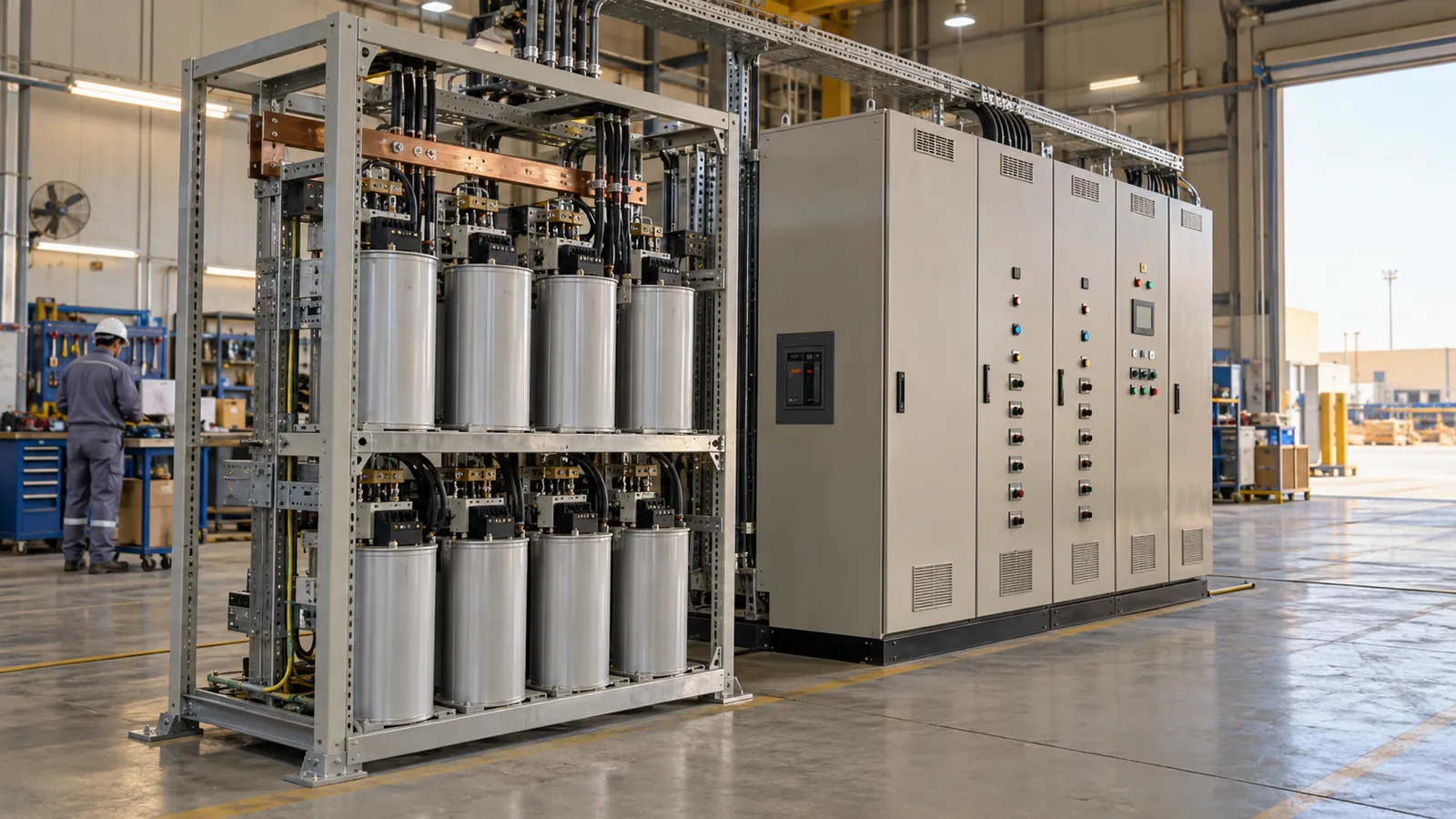
The two types are fixed and automatic. A fixed bank has capacitors that stay switched on whenever the supply is on, with no controller. An automatic bank, built into an APFC panel, uses a power factor controller that reads the load current and adds or removes capacitor steps through contactors to hold the target power factor.
A third type, the dynamic or thyristor-switched bank, switches in milliseconds for fast loads such as welding sets and cranes. It is a faster version of the automatic bank, covered on our dynamic thyristor PFC page.
| Point | Fixed bank | APFC (automatic) panel |
|---|---|---|
| Switching | None, always connected | Controller and contactors switch steps |
| Suited load | Steady, one motor or no-load transformer losses | Load that changes by shift, season or process |
| Risk at light load | Over-correction to a capacitive power factor | Steps drop out, so the risk is low |
| Controller | None | Multi-step power factor controller with CT |
| Maintenance | Capacitor and fuse checks | Plus contactors, controller and fans |
| Cost | Lower | Higher, in proportion to the steps |
| Typical use | Motor terminals, transformer compensation | Main incomer, plant-wide correction |
When is a fixed capacitor bank enough?
A fixed bank works in two situations. The first is a single motor that runs at constant load, where the bank sits at the motor terminals and is sized to the motor's no-load magnetising current, which the datasheet gives. The second is a transformer whose magnetising reactive demand is constant, where a small bank is connected on the secondary.
The commonly used guide is that if the total correction needed is under about 15% of the transformer kVA, a fixed bank is acceptable. Above that, the load usually varies enough that a fixed bank will over-correct whenever demand drops. A fixed bank is also unsuitable where the load carries drives or other harmonic sources, unless it is detuned.
Worked example: a 1,250 kVA plant that runs day and night
This is an example to show the method; your numbers will differ. A plant has a 1,250 kVA transformer. At peak, demand is 900 kW at 0.80 power factor. At night it drops to 150 kW at 0.85. The target is 0.95.
| Condition | Calculation | Result |
|---|---|---|
| Reactive demand at peak | 900 × 0.750 | 675 kVAr |
| Correction needed at peak | 900 × (0.750 − 0.329) | about 379 kVAr |
| Reactive demand at night | 150 × 0.620 | 93 kVAr |
| Correction needed at night | 150 × (0.620 − 0.329) | about 44 kVAr |
| 15% of the transformer | 1,250 × 0.15 | 188 kVAr |
The peak correction of about 379 kVAr is twice the 188 kVAr guide limit, so a fixed bank is already the wrong tool. Suppose a 400 kVAr fixed bank is installed to cover the peak. At night the plant needs 93 kVAr but receives 400, leaving 307 kVAr of surplus capacitive reactive power. The power factor falls to 150 ÷ √(150² + 307²) = about 0.44 capacitive, the voltage rises and some tariffs treat it as a fault.
An APFC panel of 400 kVAr in eight 50 kVAr steps solves it. At night it connects one step, leaving 93 − 50 = 43 kVAr of reactive demand and a power factor of about 0.96. At peak all eight steps are connected, which gives 0.95 or better. This is why the fixed bank fails here and the automatic panel works.
APFC vs fixed capacitor bank: which should you choose?
Work down this checklist.
- Is the load steady? If it never varies by more than the size of one small step, fixed is acceptable.
- Is the correction under 15% of transformer kVA? If not, choose automatic.
- Do you run shifts, chillers, compressors or cranes? These change the reactive demand, so choose automatic. Choose thyristor switching if the load changes in seconds.
- Are there drives or UPS units? Choose a detuned version of either type.
- Do you want less maintenance? A fixed bank has fewer parts, but a failed step in an automatic panel is easy to isolate and replace.
The automatic range is on our APFC panel page and the fixed and plain banks are covered on the capacitor bank page. If you need the kVAr calculated first, see PFC panel design and sizing. Saudi Power Factor Company has worked in Saudi Arabia since 2010 and is approved by Saudi Aramco, SABIC and the Royal Commission for Jubail and Yanbu.
APFC vs fixed capacitor bank questions
What is the process of power factor correction?
The process is to measure the present power factor, calculate the kVAr needed to reach the target, choose a fixed or automatic bank, add reactors if harmonics are present, install it and set the controller. A check on the next bill confirms that the correction works.
Can a fixed capacitor bank damage my installation?
A fixed bank can cause trouble if it is too large for the minimum load. It over-corrects, raises the voltage and can resonate with drives. A bank sized to constant load, or detuned and sized with a margin, avoids this.
Can I add a fixed bank to an existing APFC panel?
Usually yes, if the total stays within the transformer and busbar limits. The fixed unit covers the base load and the panel handles the variable part. We check the combined kVAr at minimum load so the plant is not over-corrected. Send us the panel nameplate and the load data.
How much more does an APFC panel cost than a fixed bank?
The difference comes from the controller, the contactors, the extra protection per step and the larger enclosure. It grows with the number of steps. Send your kVAr need and the proposal prices both options so you can compare them.
How quickly does an APFC panel respond to load changes?
A contactor-switched panel responds within seconds, following the controller's delay setting, which suits motors and chillers. For loads that change in milliseconds, such as spot welders, a thyristor-switched panel is the better choice.
Choosing between an APFC vs fixed capacitor bank for your site? Send us your electricity bill or load profile and get a quotation within one working day.
Email: inquiry@saudipowerfactor.com | Request a quotation