
Capacitor Bank Maintenance Checklist
A capacitor bank maintenance checklist for a plant in Saudi Arabia covers six jobs: safe isolation and discharge, visual inspection, thermography under load, torque checks on terminals, capacitance measurement, and a review of controller settings. Most banks fail slowly from heat and lost capacitance, and each of those checks catches a fault before the bank stops correcting.
What you receive: a written proposal for scheduled maintenance of your capacitor banks, with scope, visit frequency and price, within one working day of receiving your panel list. Request a quotation
By Eng. Ahmed Ali, Saudi Power Factor Company. Published 9 October 2026.
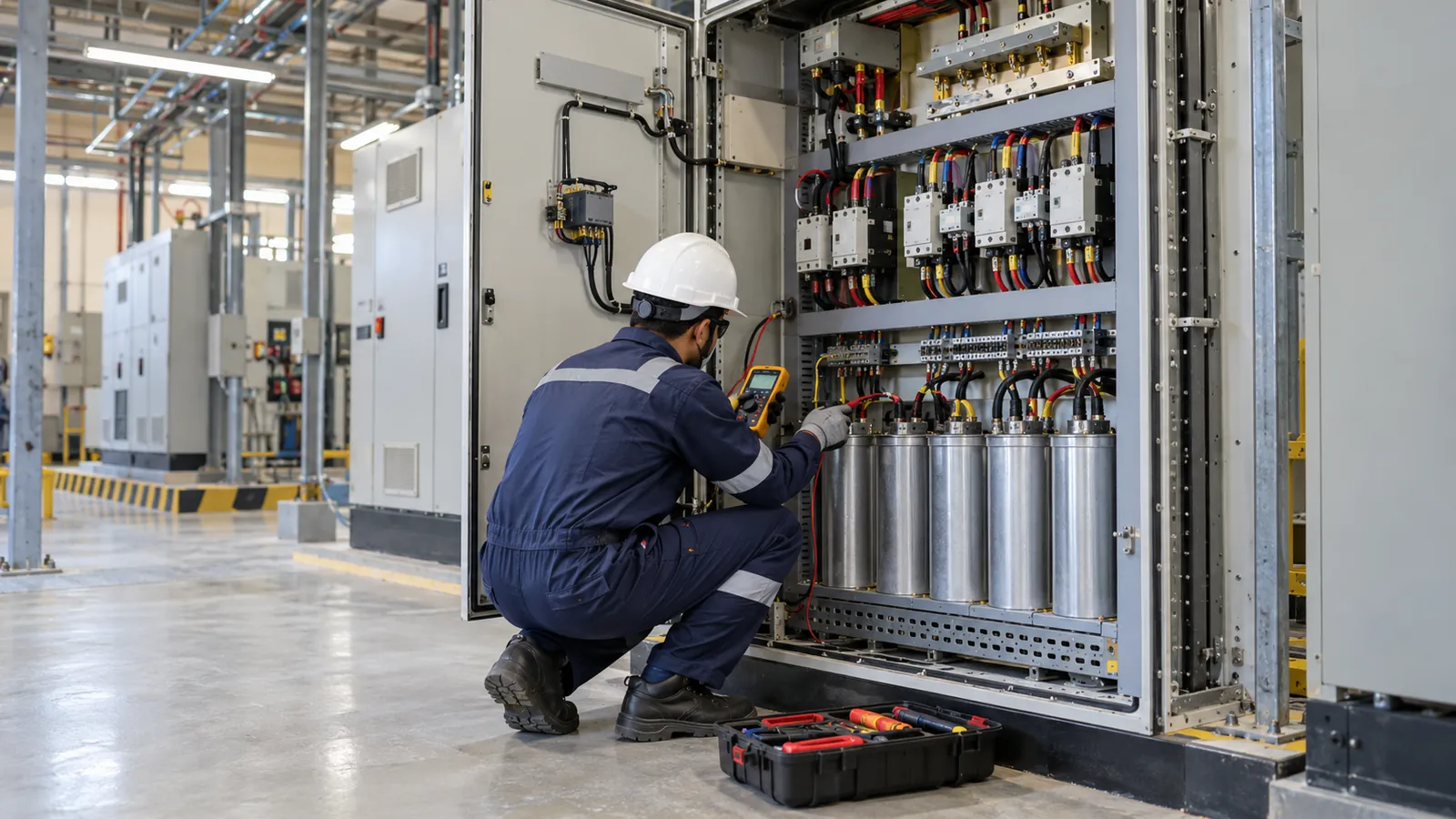
What should a capacitor bank maintenance checklist include?
The table lists each task, when to do it and what a pass looks like. Intervals are typical starting points. Adjust them to your site's heat, dust and duty, and to the capacitor datasheet. Record every reading in a logbook, because the trend from visit to visit tells you more than a single value.
| Task | Typical interval | Pass criterion |
|---|---|---|
| Visual inspection (energised, door shut) | Monthly | No bulging cans, leaks, discolouration or fan faults |
| Controller and step status | Monthly | Every step switches in and out; power factor close to target |
| Thermography under load | Every six months | No terminal or contactor visibly hotter than its neighbours |
| Isolate, lock off and discharge | Before every internal job | Voltage proved dead at the terminals |
| Terminal torque and cable condition | Annually | Terminals at the specified torque; no darkened insulation |
| Capacitance measurement | Annually | Each phase within the datasheet tolerance of its rated value |
| Contactor and fuse check | Annually | Contacts not pitted; fuses of the correct rating |
| Fan, filter and enclosure cleaning | Every three to six months | Airflow clear; filters clean; thermostat operates |
| Controller settings review | Annually | Target power factor, CT ratio and step sequence still correct |
For a bank under a service plan, our PFC maintenance contracts carry these visits for you.
How do you isolate and discharge a bank safely?
Isolate first, then wait, then prove it dead. A capacitor stays charged after the supply is removed, and the discharge resistors need time to bring the voltage down. A common design requirement is a fall to a safe voltage within about three minutes.
Follow this order every time:
- Switch the controller to manual and switch off all steps.
- Open the incoming isolator and lock it off.
- Wait for the full discharge time on the capacitor label.
- Prove the terminals dead with a tested voltage indicator.
- Short and earth the terminals before touching them, if your permit-to-work requires it.
Never rely on the discharge resistors alone, and never work on a bank that has just been switched off.
Worked example: reading a capacitance test
The figures below are assumed values for a 50 kVAr step, to show how to judge a test. They are not a client measurement.
A 50 kVAr step on a 380 V, 60 Hz supply is delta connected. Its rated capacitance per phase is:
C = 50,000 ÷ (3 × 2π × 60 × 380²) = about 306 µF
The datasheet tolerance is commonly −5% to +10%. A reading of 275 µF on one phase is:
- (306 − 275) ÷ 306 = about 10% below rating, outside the tolerance;
- equal to about 45 kVAr of the original 50 kVAr, a loss of roughly 5 kVAr.
One weak phase also unbalances the step. The next action is to replace that capacitor, not to wait for the next annual visit. When several steps show the same drift, the bank has aged or is overloaded by harmonics, and a capacitor replacement is cheaper than a series of single failures.
What do the findings tell you?
Match the symptom to the likely cause before you order parts:
- Hot terminals: loose torque or an overloaded contactor.
- Bulging can: internal failure from heat or overvoltage; replace it and look for the cause.
- Falling capacitance on every step: age, or harmonic overload on a plain bank.
- Steps that never switch in: a failed contactor, a blown fuse or a wrong CT ratio.
- Power factor still below target with all steps on: the bank is too small for the new load, so resize it. See APFC panels.
Record every reading and keep the dates. Capacitance trends over three or four years show ageing long before a failure does.
Keep a small stock of the parts that fail most often: capacitor-duty contactors, step fuses and a spare capacitor for each rating on site. Heat, dust and long running hours in Eastern Province plants shorten life, so a spare on the shelf turns a week of lost correction into a one-shift repair. Note the nameplate data of every step in the same log, so that the right part can be ordered from a photograph.
Capacitor bank maintenance checklist questions
Who provides a capacitor bank maintenance checklist service in Saudi Arabia?
Saudi Power Factor Company provides capacitor bank maintenance in Saudi Arabia, from a single annual inspection to a scheduled contract covering thermography, capacitance tests, torque checks and settings review. We report each visit in writing with readings and recommended actions.
How often should a capacitor bank be serviced?
Visual checks monthly and a full service annually suit most plants. Hot, dusty sites and banks near drives justify more frequent thermography and cleaning. The intervals in the table are a starting point, which the manufacturer's datasheet and your own failure history then refine.
What affects the cost of capacitor bank maintenance?
The factors are the number of panels, their kVAr, how many visits a year you choose, whether thermography and capacitance testing are included, and the distance engineers travel. Spares are priced separately. Send a list of your panels and we quote the visit plan.
How long does a capacitor bank service take?
A single panel takes a few hours once it is isolated, and a plant with many panels takes longer. The time depends on access, the number of steps and whether shutdown windows are limited. We agree the schedule with you before the visit.
Can maintenance be done without shutting down the plant?
Partly. Visual inspection and thermography are done with the bank energised and the door shut. Capacitance tests and torque checks need the bank isolated, which we plan for a low-load period. Panels with several sections can be done one at a time.
Need a capacitor bank maintenance checklist carried out for you? Send us your panel list or a photo of the nameplates and receive a quotation within one working day.
Email: inquiry@saudipowerfactor.com | Request a quotation