
Power Factor Penalty Calculation for a Saudi Electricity Bill
A power factor penalty calculation compares the reactive energy (kVArh) your bill records with the free allowance your tariff gives at its minimum power factor, then prices the excess. A plant at 0.80 power factor using 180,000 kWh a month records about 47,800 kVArh above a 0.90 allowance, and that excess is what the charge is built on.
What you receive: if you send one month of your electricity bill, a written proposal with the correction needed, the panel rating and the price within one working day. Request a quotation
By Eng. Ahmed Ali, Saudi Power Factor Company. Published 9 October 2026.
What does a power factor penalty charge you for?
It charges you for reactive power, the part of the current that magnetises motors and transformers and does no useful work. Power factor is the ratio of kW to kVA. The lower it is, the more current your cables and transformer carry for the same useful load, and the utility recovers that cost from you.
Utilities use one of three charging methods. Your bill shows which one applies, so identify it before you calculate anything.
| Method | What the bill shows | What you calculate |
|---|---|---|
| Reactive energy charge | kWh and kVArh for the month | kVArh above the allowance, times the rate per kVArh |
| Percentage surcharge | Power factor or a penalty line | Surcharge percentage times the energy or demand charge |
| kVA-based billing | Demand in kVA, not kW | The extra kVA caused by the power factor, times the demand rate |
Which method SEC applies to your tariff class, and the minimum power factor it sets, must be read from your own bill or the current tariff schedule. In the Saudi Electricity Company tariff the 0.90 minimum applies above 1 MVA contract load, and reactive energy beyond 48.4% of active energy is billed at 5 halalas per kVArh. Sizing to 0.95 keeps you clear of that limit and of the planned 0.95 minimum. The method below works for the reactive energy charge, which is the one most plants can check from two lines on the bill.
How is the power factor penalty calculation done step by step?
The calculation needs only the monthly kWh and kVArh. Follow these steps.
- Read the energy lines. Note the active energy in kWh and the reactive energy in kVArh for the billing month.
- Find your actual power factor. Use PF = kWh ÷ √(kWh² + kVArh²).
- Set the allowance. Allowed kVArh = kWh × tan(arccos of the minimum power factor). The multiplier is 0.484 at 0.90 and 0.329 at 0.95.
- Find the excess. Chargeable kVArh = recorded kVArh minus allowed kVArh. If the answer is negative, there is nothing to pay.
- Price it. Multiply the excess by the rate on your tariff, then multiply by twelve for the annual cost.
Do the same arithmetic for every month of the year. A single month hides the pattern, and the bills with the largest excess usually show where the problem sits in your load.
Worked example: what does a 0.80 power factor cost in a year?
This is an example to show the method. The tariff rate is assumed for the calculation and is not an SEC rate; replace it with the figure on your own bill.
| Line | Value |
|---|---|
| Active energy | 180,000 kWh |
| Reactive energy recorded | 135,000 kVArh |
| Actual power factor | 180,000 ÷ √(180,000² + 135,000²) = 0.80 |
| Minimum power factor assumed | 0.90 |
| Allowed reactive energy | 180,000 × 0.484 = 87,174 kVArh |
| Chargeable excess | 135,000 − 87,174 = 47,826 kVArh |
| Assumed rate | SAR 0.05 per kVArh |
| Monthly charge | 47,826 × 0.05 = about SAR 2,391 |
| Annual charge | About SAR 28,700 |
Now correct the plant to 0.95. The reactive energy that remains is 180,000 × 0.329 = about 59,200 kVArh. That is below the 87,174 kVArh allowance, so the charge falls to zero. The saving each year equals the whole penalty, and the capacitor equipment is sized to remove the 135,000 − 59,200 = 75,800 kVArh a month. The kVAr rating that does this at your peak demand comes from the method in our guide to PFC panel design and sizing.
Why does the penalty change from month to month?
Because the reactive energy follows your load, not the calendar. Four causes repeat across plants:
- Lightly loaded motors draw almost as much magnetising current as fully loaded ones, so a quiet month has a worse power factor.
- Chillers and compressors run harder in summer, which moves the reactive demand with the weather.
- A capacitor bank that has lost capacitance or has failed steps corrects less each month.
- Over-correction is also possible. If a fixed bank is left connected at night, the plant can swing to a capacitive power factor, which some tariffs treat differently.
Compare twelve months of bills before you choose a fix. If the excess is highest in summer, the panel needs steps that follow the load; if it is steady, a smaller fixed unit may be enough.
How do I remove the penalty for good?
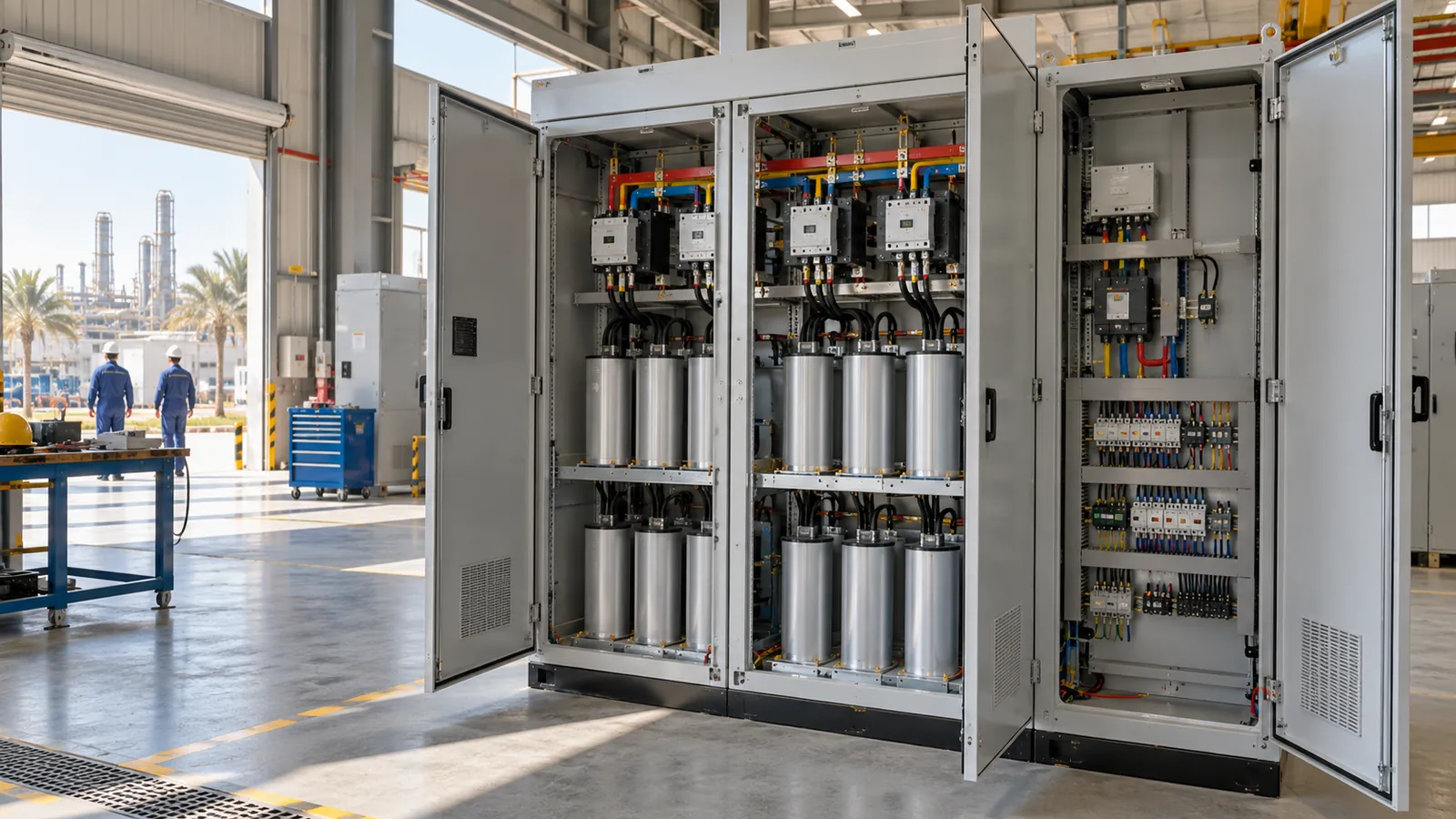
Match the correction to the pattern in your bills. A variable load needs an automatic panel that switches capacitor steps to hold your target. A load with harmonics from drives needs detuned reactors. A steady load can use a fixed bank.
If you want the commercial side, read how we remove the power factor penalty on Saudi bills. If you want to diagnose a bill that has just arrived, the low power factor penalty problem page walks through the symptoms. When the answer is an automatic assembly, the range is on the APFC panel page. Since 2010 Saudi Power Factor Company has held approvals from Saudi Aramco, SABIC and the Royal Commission for Jubail and Yanbu.
Power factor penalty questions
What is a power factor penalty?
It is an extra charge on your electricity bill when your plant draws more reactive power than the tariff allows. The charge appears as a kVArh line, a surcharge or a higher kVA demand. It reflects the extra current the utility must carry for the same useful kW.
What minimum power factor does SEC require?
The threshold depends on the tariff class and how the meter measures it, so read it from your own bill or the current SEC schedule. Many industrial tariffs use 0.90 as the reference. We size the correction a little above whatever figure applies, so normal load swings stay compliant.
Can I do the calculation from a single month of data?
Yes, a single bill gives you the actual power factor and the monthly charge. Twelve months show whether the penalty is seasonal, which decides whether you need a fixed bank or an automatic panel. Send us the latest bill and we will work from that.
How much can correction save compared with its cost?
The yearly saving equals the penalty you stop paying, plus smaller gains from lower losses and released capacity. In the example above, the annual charge is about SAR 28,700. Divide the cost of the panel by that figure to get the payback. Our proposal sets out both numbers.
Does improving power factor reduce my kWh?
Not directly. Correction removes reactive current, so cable and transformer losses fall slightly, but the kWh your equipment uses stays almost the same. The saving comes from the penalty removed, the capacity released on your transformer and the lower voltage drop at the load.
Need a power factor penalty calculation done on your own bill? Send us one month of your electricity bill and get a quotation within one working day.
Email: inquiry@saudipowerfactor.com | Request a quotation