
Power Factor Correction ROI Payback Period
Power factor correction ROI payback in Saudi Arabia is the installed price divided by the monthly saving. The saving comes mainly from a power factor charge removed from the bill, where your tariff applies one, plus lower cable losses and released transformer capacity. A plant with no charge on its bill has a much longer payback than a plant with one.
What you receive: a written proposal with the kVAr rating, standard, lead time and price within one working day of receiving your electricity bill, so you can run the payback sum with a firm number. Request a quotation
By Eng. Ahmed Ali, Saudi Power Factor Company. Published 9 October 2026.
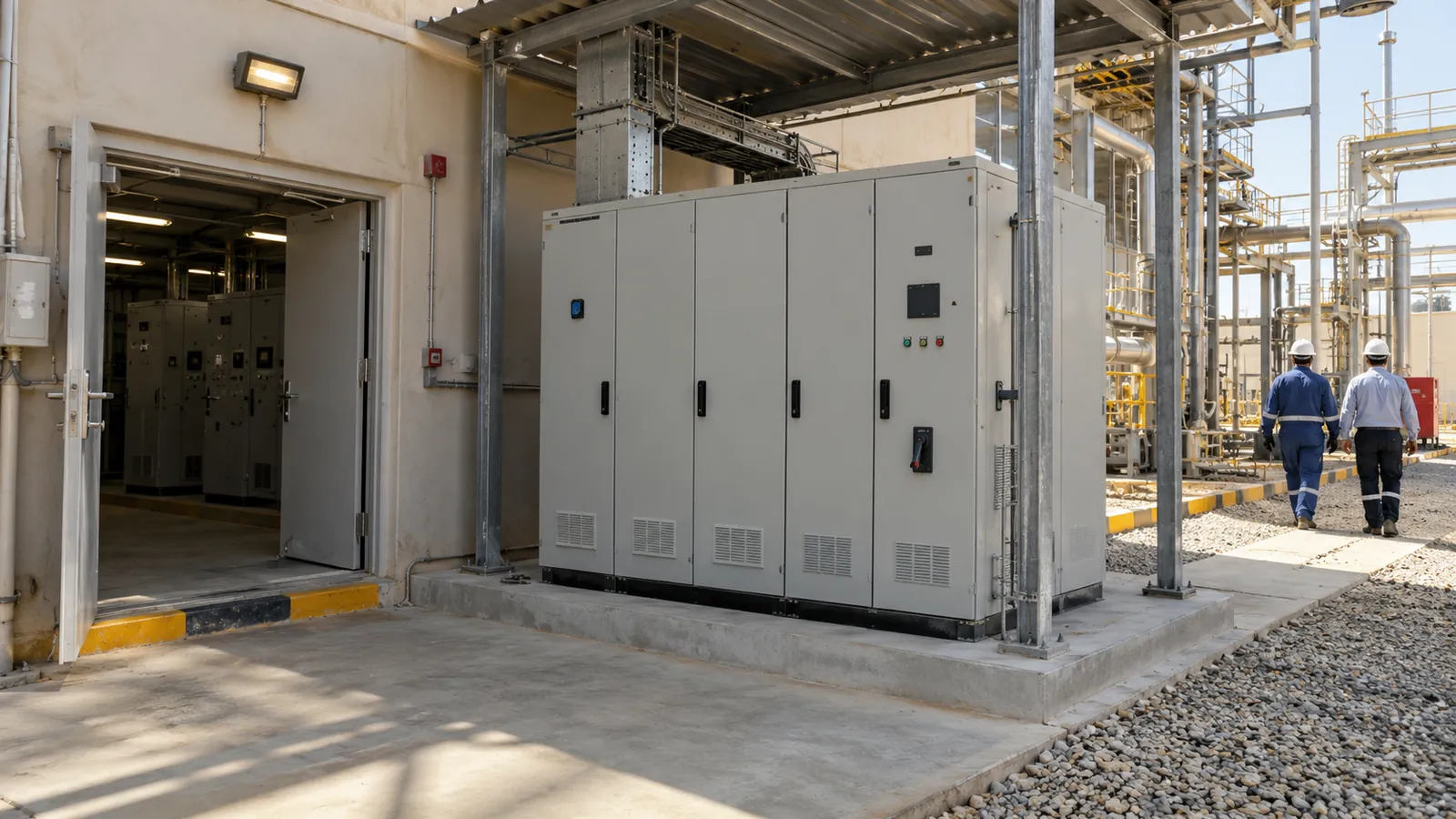
Where does the saving from power factor correction come from?
There are four sources. Only the first appears as a line on the bill, which is why the others are often left out of a payback sum.
| Source of saving | How to measure it | Reliability |
|---|---|---|
| Power factor charge removed | The monthly charge on the bill, before and after | High, read straight from the bill |
| Lower cable and transformer losses | Current falls with power factor; losses fall with the square of current | Medium, depends on the cable lengths |
| Released transformer or cable capacity | Extra kVA available without an upgrade | High where an upgrade is planned |
| Longer equipment life | Cooler cables and switchgear | Low, not usually counted |
Whether your tariff charges for low power factor, and from what threshold, is set by SEC. Under the Saudi Electricity Company tariff: 0.90 is the minimum above 1 MVA contract load; we design to 0.95. Our power factor penalty page explains how we approach it, so use the bill, not an assumption.
How do you calculate power factor correction ROI payback?
Use five steps and your own figures.
- Read the monthly charge. Take the power factor charge from the last twelve bills and average it, because load changes through the year.
- Add the secondary savings. Count them only if you can put a number on them, such as a transformer upgrade you can now avoid.
- Get the proposal price. The price covers the panel, delivery and commissioning. A power quality survey first may be worth adding if the load is unusual.
- Divide. Payback in months equals the proposal price divided by the monthly saving.
- Test it. Run the sum again with a saving 25% lower, to see whether the project still earns its place.
Worked example: payback from an assumed bill
The values here are assumed, to show the arithmetic. They are neither a quotation nor a client result.
A plant averages a power factor charge of SAR 5,000 a month, with a power factor of 0.78. The correction brings it to 0.95.
- Current falls by the ratio 0.78 ÷ 0.95 = 0.82, a cut of about 18% for the same kW.
- Loss in cables falls with the square of current: 0.82² = 0.67, so cable losses drop by about 33%. Convert that to riyals only if you know the cable loss in kWh.
- Monthly saving counted: SAR 5,000, the charge removed, with the loss saving left out to stay conservative.
The grid shows the payback in months for a range of monthly savings and proposal prices. Find your own two numbers and read across.
| Proposal price | Saving SAR 2,500 a month | Saving SAR 5,000 a month | Saving SAR 10,000 a month |
|---|---|---|---|
| SAR 30,000 | 12 months | 6 months | 3 months |
| SAR 60,000 | 24 months | 12 months | 6 months |
| SAR 90,000 | 36 months | 18 months | 9 months |
The prices in the left column are inputs for the arithmetic, not our prices. Every SAR 10,000 of proposal value adds two months at a saving of SAR 5,000. Because a correct size removes the charge fully, over-sizing adds cost without adding saving. The APFC panel is sized from your demand, not from the charge alone.
What makes the payback longer than expected?
Four things stretch payback, and all four are avoidable:
- Oversized correction. Extra kVAr beyond the target earns nothing and can push the supply into an over-corrected, capacitive condition.
- Wrong capacitor type. Plain capacitors on a supply full of drives fail early, so the bank must be replaced.
- Poor step control. Steps too large for the load swing above and below the target, and some intervals still carry a charge.
- An unmeasured load. A guessed demand gives a wrong kVAr. Sizing from billing data is the fix, as set out in PFC panel design and sizing.
Which costs should the payback sum include?
Count the full installed cost, not only the panel. Leaving items out makes the payback look shorter than it will be.
- the panel, with its capacitors, reactors and controller;
- delivery and positioning at the site;
- cabling and the incoming breaker supplied by your electrical contractor;
- a power quality survey, where the load or harmonics are uncertain;
- commissioning and the first-year warranty cover; and
- a yearly maintenance visit, which keeps the saving in place.
If the quotation separates these lines, each can be questioned. If it gives a single figure, ask for a breakdown, because the bank is only worth what it saves for as long as it keeps working.
Power factor correction ROI payback questions
Who can calculate power factor correction ROI payback for my plant?
Saudi Power Factor Company provides the payback calculation with every proposal in Saudi Arabia. Send one month of your electricity bill, ideally twelve, and we state the kVAr, the price and the monthly saving counted, so your finance team can check each figure.
What affects the cost of power factor correction?
The main factors are total kVAr, number of steps, detuning reactors, enclosure and IP rating, controller make, and the testing you require. The kVAr and the harmonic content matter most. Because cost sets the top of the payback sum, send your load details early.
How long does it take to recover the cost?
It depends on the size of your monthly charge compared with the proposal price. Use the grid above: a larger charge or a smaller bank shortens it. We cannot give a figure before reading your bill, because two plants of the same size can pay very different charges.
Is a power factor of 0.9 good enough?
It depends on your tariff. If the tariff charges below 0.9 and your plant sits close to that line, the charge may be small, and the payback long. A plant well below the line has a short payback. Check the threshold in your tariff and bill.
Can power factor correction pay for itself without a charge on the bill?
Sometimes, when it releases capacity. If the transformer is at its limit and a larger one is planned, correction can defer that spend. That gain is real but site-specific, so put a number on it before you count it.
Ready to run your own power factor correction ROI payback? Send us one month of your electricity bill and receive a quotation within one working day.
Email: inquiry@saudipowerfactor.com | Request a quotation