
Target Power Factor in Saudi Arabia: 0.9 or 0.95?
Set your target power factor in Saudi Arabia slightly above the threshold your SEC tariff uses, not on it. If the threshold is 0.9, as in the Saudi Electricity Company tariff for contract loads above 1 MVA, a target of 0.95 leaves a margin for load swings. Going beyond 0.95 adds capacitors with little extra saving.
What you receive: a written proposal with the kVAr, target power factor, standard, lead time and price within one working day of receiving your electricity bill. Request a quotation
By Eng. Ahmed Ali, Saudi Power Factor Company. Published 9 October 2026.
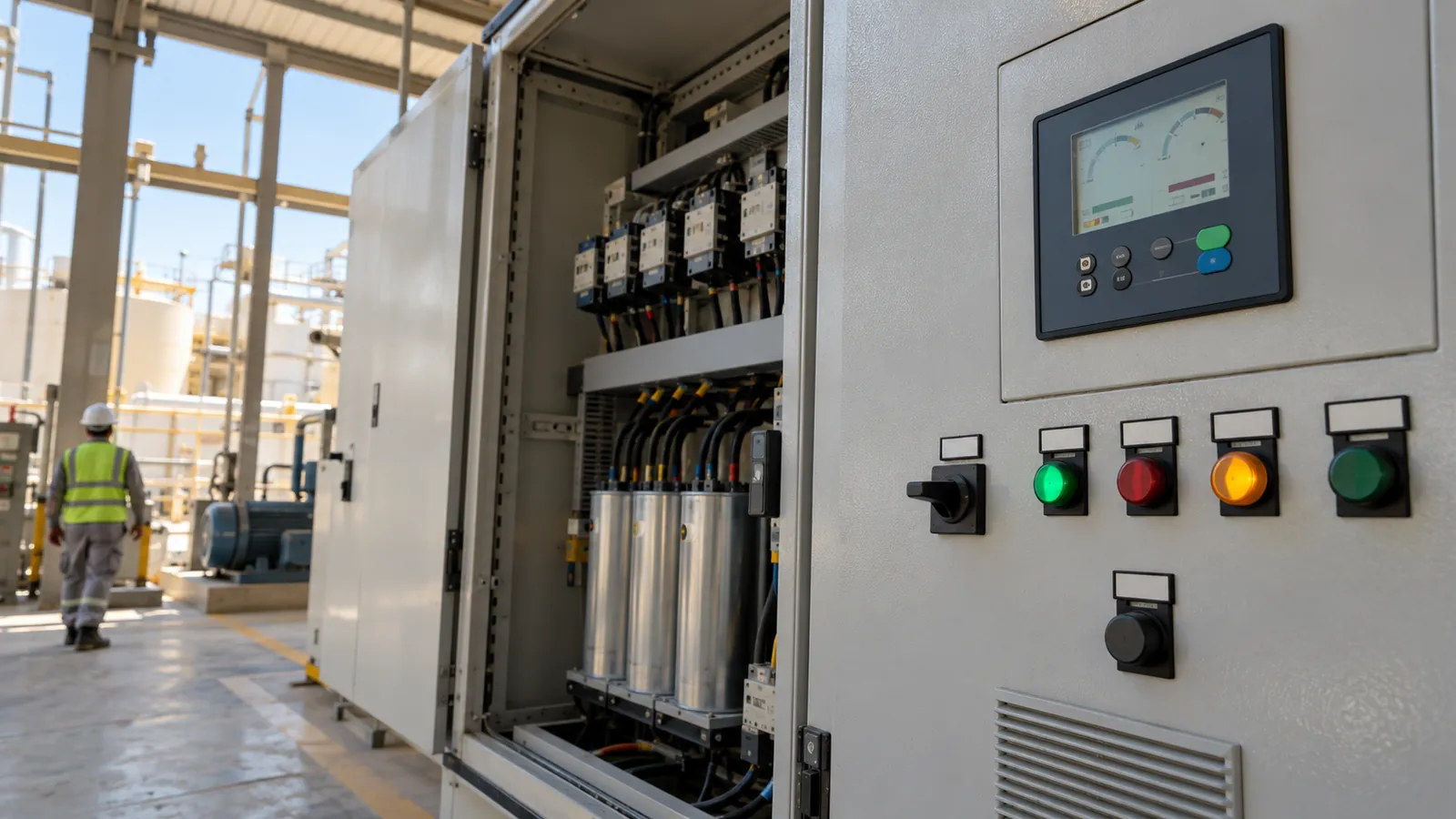
What does 0.9 versus 0.95 power factor actually mean?
Power factor is kW divided by kVA. At 0.9, a plant draws 1.11 kVA for each kW of useful power. At 0.95, it draws 1.05 kVA. The difference is smaller than many buyers expect, but it matters at the edge of a tariff line.
| Power factor | kVA per kW | Current compared with 0.9 | Reactive power per kW |
|---|---|---|---|
| 0.90 | 1.11 | 100% | 0.48 kVAr |
| 0.95 | 1.05 | 95% | 0.33 kVAr |
| 0.98 | 1.02 | 92% | 0.20 kVAr |
The rule that decides your bill is a tariff rule, set by SEC. Read your own bill and tariff schedule for the threshold, the period it is averaged over and whether it is billed per month. Our power factor penalty page covers how a charge arises.
Two questions to answer from the bill before you pick a number: is the power factor averaged over the month or judged at the peak, and is the charge triggered below a fixed value or scaled by how far you fall short? A plant averaged over the month has more room than one judged on its worst interval, and the target should reflect that. Where the bill gives no power factor line at all, ask your SEC account contact to confirm the rule that applies to your supply category.
Why choose a target above the threshold?
Because your actual power factor is never steady. A controller that holds exactly 0.90 will spend part of the day at 0.88 and part at 0.92. If the bill uses an average or a minimum, the dips matter. A target of 0.95 gives a margin of 0.05 for motor starts, lightly loaded hours and step size. A controller also needs a dead band, so the real value wanders around the setting.
Three things push the achieved value away from the target:
- Step size. A 50 kVAr step cannot correct a 20 kVAr shortfall.
- Load swings. Lifts, cranes and presses change faster than contactors can follow.
- Metering location. The CT must sit on the incomer, upstream of all loads and the bank.
Worked example: what 0.9, 0.95 and 0.98 cost in capacitors
The load below is an assumed case that shows the diminishing return. It is not a client plant.
A plant has an 800 kW demand at a present power factor of 0.80 [assumed]. For three targets, the kVAr to add is 800 × (tan of the present angle − tan of the target angle).
- To reach 0.90: 800 × (0.750 − 0.484) = about 213 kVAr.
- To reach 0.95: 800 × (0.750 − 0.329) = about 337 kVAr.
- To reach 0.98: 800 × (0.750 − 0.203) = about 437 kVAr.
Raising the target from 0.90 to 0.95 adds about 124 kVAr, and 0.95 to 0.98 adds another 100 kVAr. At the 0.9 setting the supply carries 889 kVA; at 0.95 it carries 842 kVA; at 0.98 it carries 816 kVA. The first step gains 47 kVA of capacity and the second gains 26 kVA. The extra capacitors beyond 0.95 therefore buy less each time. Choose the higher target only when your bill, or your transformer, gives a reason.
Is a higher power factor always better?
Not always. Beyond unity the supply turns capacitive, and an oversized bank can raise the voltage and upset generators and drives. Over-correction can occur at low load if the bank cannot switch off enough steps. A controller with a sensible minimum step and a correct CT ratio prevents it.
Sizing with margin, not excess, is the method behind PFC panel design and sizing. If your bill shows a charge today, see low power factor penalty on your electricity bill for the diagnosis, and the APFC panel page for the equipment that holds the target automatically.
How do you set and check the target on the controller?
Set it, then prove it with a week of data. The controller holds the number you enter, but only a measurement shows what the plant achieves.
- Enter the target on the controller, with a small dead band so the steps do not hunt.
- Check the CT ratio and the CT location: it must see the whole plant current.
- Run the plant through a full working week, including the weekend.
- Compare the logged power factor with your bill, interval by interval.
- Review the setting whenever you add large motors or drives.
A bank that read 0.95 on the day of commissioning can drift after a change in load. A yearly check keeps it where you set it.
Target power factor in Saudi Arabia questions
Who helps set a target power factor in Saudi Arabia?
Saudi Power Factor Company provides power factor correction to the target you set, from sizing on your bill to commissioning the controller on site. We state the target, the kVAr and the step layout in the proposal so your engineers can check them against the tariff.
Is 0.9 power factor good?
It is acceptable where your tariff threshold is 0.9 and the load is steady, but it leaves no margin. Any dip below the line may be charged. Most plants choose 0.95 so that normal swings in load stay on the right side of the threshold.
What does 0.95 power factor mean?
It means the plant draws 1.05 kVA for every 1 kW of useful power, so reactive power is about a third of the real power. It is a common design target because it sits above the usual threshold without needing a large extra bank.
What affects the cost of reaching a higher target?
The kVAr grows with each step up in target, as the example shows, and so do the number of steps and the enclosure size. Detuning, if needed, adds reactors as well. Send your bill and we price the 0.90, 0.95 and 0.98 options side by side.
How long does it take to correct to the target?
A panel's lead time depends on kVAr, reactors and drawing approval. Our typical lead time is 2–3 weeks for an APFC panel and 3–4 weeks for a detuned bank. Once energised, the controller reaches the target within seconds of the load settling, and commissioning confirms it under real load.
Not sure which target power factor in Saudi Arabia suits your site? Send us one month of your electricity bill and we show the kVAr for each option, with a quotation within one working day.
Email: inquiry@saudipowerfactor.com | Request a quotation