
VFD Harmonics and Power Factor in Saudi Plants
VFD harmonics reduce the true power factor of a plant even when each drive shows a displacement power factor near 0.97. True power factor equals displacement power factor multiplied by a distortion factor, so a drive load with 35% current distortion falls from 0.97 to about 0.92. Capacitors added to correct it need reactors.
What you receive: if you send your electricity bill and a list of your drives, a written proposal covering the correction, reactor and filter options with ratings and prices within one working day. Request a quotation
By Eng. Ahmed Ali, Saudi Power Factor Company. Published 9 October 2026.
Why does a drive have a good power factor and still cause trouble?
A variable frequency drive with a diode rectifier draws current from the supply only at the voltage peaks, in short pulses. The pulses are in phase with the voltage, so the displacement power factor, the angle between fundamental current and voltage, stays high at about 0.95 to 0.98. That is why a drive needs little reactive power from the supply.
The pulses are not a sine wave. They contain currents at 5, 7, 11 and 13 times the supply frequency, which on a 60 Hz system means 300, 420, 660 and 780 Hz. These harmonic currents flow through the transformer and cables, heat them and distort the voltage for every other load.
Two numbers describe the effect:
- THDi, the total harmonic distortion of current, measured at the drive or at the incomer.
- Distortion factor, equal to 1 ÷ √(1 + THDi²). It shows how much the harmonics reduce the true power factor.
How much do harmonics lower the power factor?
True power factor equals displacement power factor times the distortion factor. The table shows the second term.
| THDi | Distortion factor | True PF with displacement PF of 0.97 |
|---|---|---|
| 10% | 0.995 | 0.965 |
| 20% | 0.981 | 0.951 |
| 30% | 0.958 | 0.929 |
| 40% | 0.928 | 0.900 |
| 60% | 0.857 | 0.831 |
| 80% | 0.781 | 0.757 |
Drives without a line reactor or DC choke can reach 80% THDi at partial load, while drives with a 3 to 5% line reactor often fall in the 30 to 40% range. Active front-end drives are lower still.
Whether your bill reflects displacement or true power factor depends on how the meter measures reactive energy. The Saudi Electricity Company tariff compares monthly reactive energy with active energy, so check your bill to see which basis applies. The harmonic effect on losses, heating and tripping exists either way.
Worked example: a pumping plant with ten drives
This is an example to show the method. The plant has a 1,000 kVA transformer feeding ten 55 kW drives, a total of 550 kW. The drives show THDi of 35% at the incomer and a displacement power factor of 0.97.
| Step | Calculation | Result |
|---|---|---|
| Distortion factor | 1 ÷ √(1 + 0.35²) | 0.944 |
| True power factor | 0.97 × 0.944 | about 0.92 |
| Apparent power at 550 kW | 550 ÷ 0.9155 | about 601 kVA |
| Apparent power if sinusoidal | 550 ÷ 0.97 | about 567 kVA |
| Extra kVA from the harmonics | 601 − 567 | about 34 kVA |
The harmonics add about 31 kVA of load on the transformer and cables for the same 550 kW of work. Now suppose the plant also has 150 kVAr of plain capacitors for older motors. The capacitor and the 6% impedance transformer resonate at √(1,000 ÷ 0.06 ÷ 150) = about 10.5, close to the 11th harmonic, so the 11th-order current is amplified. Fuses blow, the capacitors overheat and the drives report faults. A detuned bank on the same supply moves the resonance below the 5th harmonic and avoids this.
What should you do about VFD harmonics?
Match the remedy to the measured distortion, not to the number of drives.
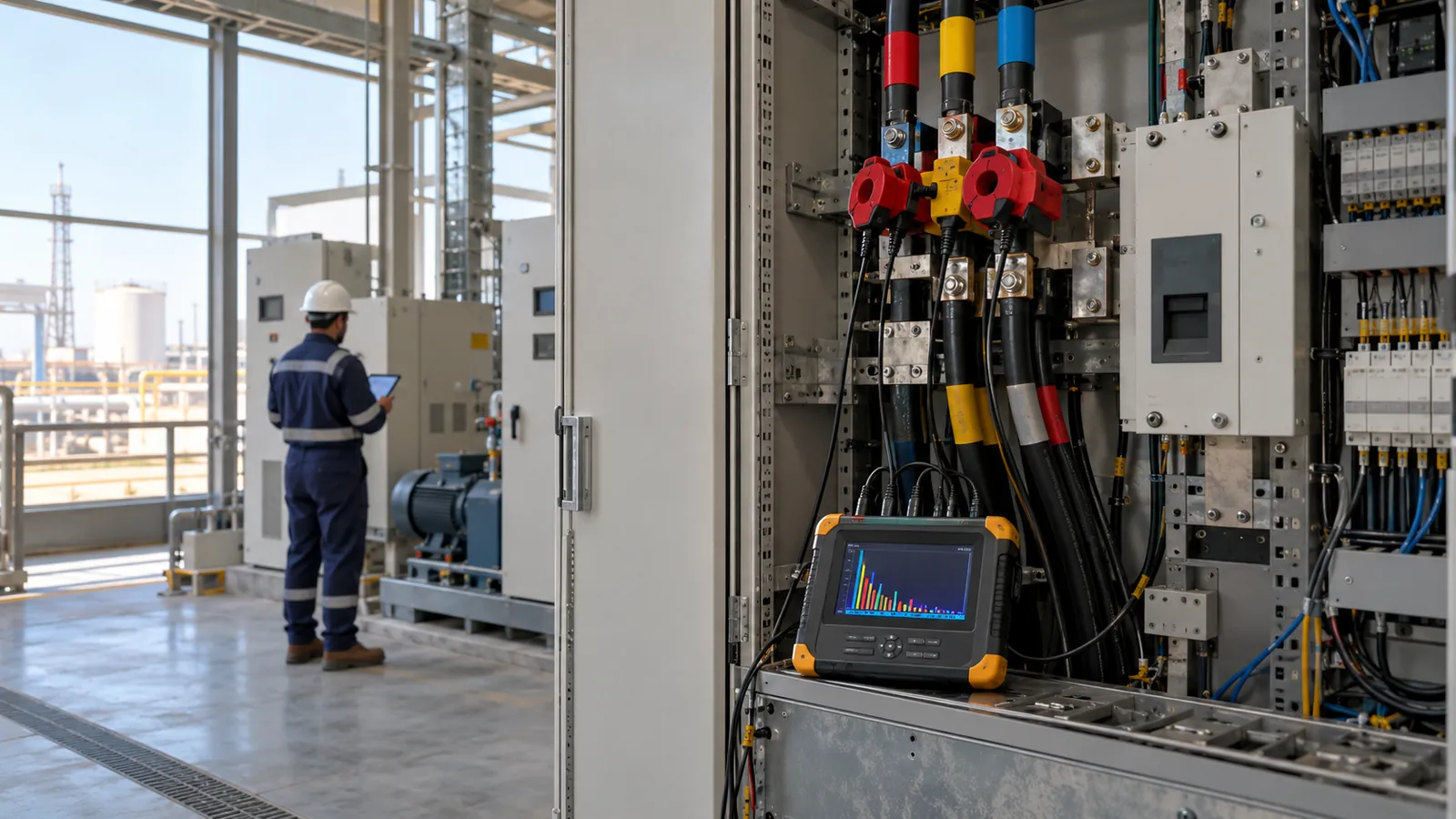
- Measure first. A power quality analyser records THDi, THDv and the spectrum at the incomer and at the largest drive.
- Compare with the limit. IEEE 519 limits voltage distortion at the point of common coupling to 5% for systems up to 1 kV, and sets current limits by the ratio of short-circuit current to load current. Your client or consultant may require it.
- Use the cheapest fix that works. A line reactor or DC choke on the drive cuts THDi sharply. A detuned capacitor bank corrects the power factor safely. A passive or active filter is for the cases where the limits are still exceeded.
- Correct the power factor with reactors. Where any capacitors share the supply with drives, use the 7% or 14% reactor option, depending on the spectrum.
- Re-measure after commissioning. A second recording confirms the distortion and the power factor are both within limits.
Our power quality survey covers steps 1 and 2. Our Italian technology partner, Elcontrol Energy Net, supplies the power quality analysers we use on many projects. The correction in step 4 is described on the detuned capacitor bank page, and filters for the cases in step 3 are on the harmonic filter panels page.
Where do VFD harmonics cause faults?
The effects show up in a few places first:
- Capacitor banks with blown fuses or bulging cans.
- Transformers and neutral conductors that run warm at moderate load.
- Breakers and RCDs that trip with no overload.
- Sensitive controls and PLCs that reset or lose communications.
- Generators that hunt or overheat when the plant switches over.
If you recognise these symptoms, start with the diagnosis page on harmonics tripping and nuisance faults. Saudi Power Factor Company, active in the Kingdom since 2010, is an approved supplier to Saudi Aramco, SABIC and the Royal Commission for Jubail and Yanbu.
VFD harmonics and power factor questions
Do VFDs improve or worsen power factor?
A drive improves the displacement power factor of the motor it controls, because the supply side sees a high power factor at all speeds. It worsens the true power factor by adding harmonic distortion. The net effect depends on the drive input design and the size of the line reactor.
Do I need to correct power factor on a VFD supply?
Usually not at the drive itself, because the displacement power factor is already high. Correct for the other motors and loads on the same supply, and do it with a detuned bank so the capacitors do not resonate with the drive harmonics.
What THDi is too high?
There is no single figure, because limits depend on your short-circuit ratio and the standard your client applies. IEEE 519 sets the limit for each site. As a practical guide, THDi above about 30% at the incomer is worth investigating, and a survey gives the exact answer.
How much does a harmonic study cost?
The cost depends on the number of measurement points, the logging period and whether a written report with recommendations is required. A short survey at the incomer costs less than a study across several feeders. Send us the single-line diagram and your drive list for a proposal.
How long does a power quality survey take?
Logging normally runs for seven days to capture a full production cycle. The report follows after the analysis. Survey teams mobilise within one working day in the Eastern Province; we fix the report date in the quotation once the points and logging period are known, and we plan the connection day with your maintenance team.
Dealing with VFD harmonics and a falling power factor? Send us your bill and the single-line diagram showing your drives, and receive a quotation within one working day.
Email: inquiry@saudipowerfactor.com | Request a quotation