
Capacitor Bank vs Harmonic Filter: The Difference
A capacitor bank corrects reactive power from motors and transformers. A harmonic filter reduces harmonic current or voltage distortion from non-linear loads such as drives and rectifiers. In a capacitor bank vs harmonic filter decision, choose correction for a low reactive-power reading, filtering for measured distortion, and a coordinated design when both occur.
What you receive: send one month of your electricity bill and receive a quotation within one working day. Request a quotation
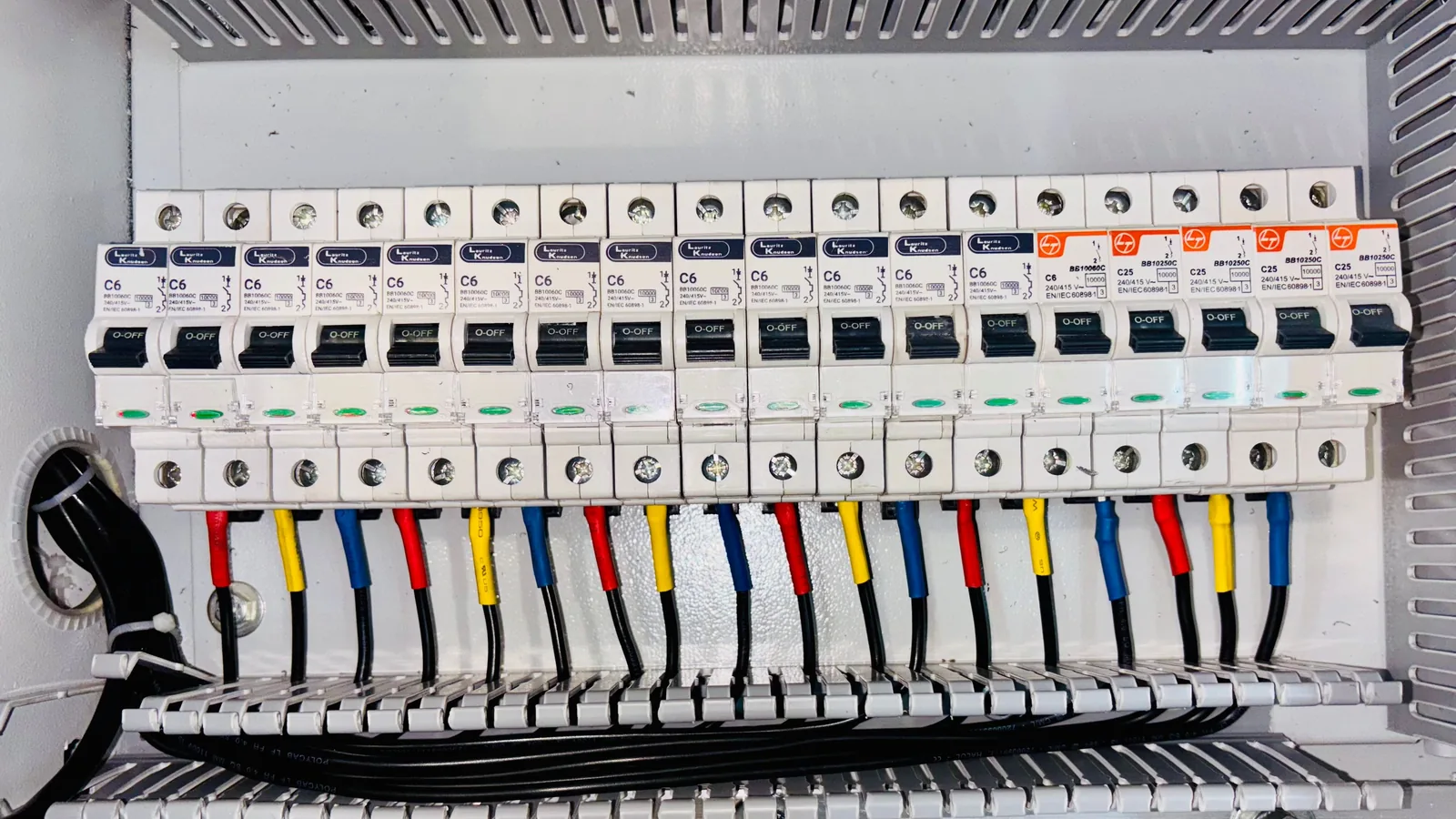
By Eng. Ahmed Ali, Saudi Power Factor Company. Published 15 October 2026.
What is the capacitor bank vs harmonic filter difference?
The two systems answer different electrical questions. A capacitor bank supplies reactive kVAr locally so the incoming supply carries less reactive current. This improves displacement power factor where motors, transformers and other inductive loads are the main cause of the low reading.
A harmonic filter is selected to manage distortion created by non-linear equipment. Variable frequency drives, rectifiers, UPS units and similar electronic loads draw non-sinusoidal current. That current can heat equipment, affect voltage quality and interact with capacitor steps. A filter is assessed from a measurement of the spectrum and the supply conditions, not from a power-factor number alone.
| Comparison point | Capacitor bank | Harmonic filter |
|---|---|---|
| Main purpose | Supplies reactive kVAr for inductive loads | Reduces selected harmonic current or distortion |
| Starting evidence | Bill, kWh, kVArh and power-factor data | Harmonic survey and measured spectrum |
| Typical result | Lower reactive demand and lower current | Lower distortion at the measured point |
| Main design concern | Step size and avoiding over-correction | Harmonic orders, source impedance and target point |
| Risk of using it alone | Does not remove existing harmonic currents | Does not automatically correct all reactive demand |
The systems can be installed together, but they should not be treated as substitutes. A site can have a poor power factor with little distortion, high distortion with an acceptable displacement power factor, or both conditions on the same incomer.
When does a capacitor bank solve the problem?
A capacitor bank is the usual starting point when the bill shows reactive energy and the site has mainly motors, transformers, pumps, compressors or other inductive equipment. It can be fixed where the load is steady, or divided into automatic steps when the load changes through the day.
The important question is the reactive demand at the operating condition, not simply the transformer rating. A correct study checks kW, the present power factor, the desired target, the supply voltage and how the load moves. Saudi Power Factor Company designs correction systems to target 0.95 after checking those inputs.
Where the incoming supply has little harmonic-producing equipment, a properly specified bank can improve the reactive-power position without the added complexity of filtering. The capacitor banks service explains the fixed and automatic options and the information needed to size the kVAr steps.
A plain capacitor bank should not be used as a harmonic remedy. If drives or other non-linear loads share the busbar, the capacitor steps may need detuned reactors or a separate harmonic solution. The right choice follows the measured condition rather than the appearance of the panel.
When does a harmonic filter solve the problem?
A harmonic filter is considered when a power quality survey shows distortion that needs to be controlled. The survey records the waveform and harmonic components at the relevant point, then the design considers where the current is produced, how the supply responds and what level must be achieved after treatment.
Some filters are passive networks tuned for particular harmonic orders. Others are active systems that inject compensating current. The choice is not made from the size of one motor or from a general rule about the number of drives. It depends on the measured spectrum, the load profile and the electrical network around the point of connection.
A filter may be needed even where the bill does not show a reactive-energy charge. Distortion can still affect transformers, cables, protection devices and sensitive controls. Conversely, a low power-factor number does not by itself prove that a harmonic filter is required.
Our harmonic filter panels page covers filter-panel applications for facilities with variable frequency drives and other harmonic loads. A survey is the basis for deciding whether a filter, detuned capacitor bank or another measure is appropriate.
What does an assumed-load example show?
The following example uses assumed values only. A plant has a 500 kW load at a power factor of 0.82 and intends to reach 0.95. The calculation shows the correction question; it does not prove that a filter is required.
| Example line | Assumed value | Calculation or implication |
|---|---|---|
| Active load | 500 kW | Useful load remains 500 kW |
| Existing power factor | 0.82 | Apparent power is about 610 kVA |
| Target power factor | 0.95 | Apparent power is about 526 kVA |
| Reactive correction | about 185 kVAr | Difference between the two reactive demands |
| Harmonic decision | Not yet known | Requires a measured spectrum |
At 0.82, the assumed 500 kW load needs about 610 kVA from the supply. At 0.95, it needs about 526 kVA. The reactive-power difference is about 185 kVAr, so an automatic bank could be assessed to supply that amount in suitable steps.
Now assume the same plant has several drives. That fact alone does not tell you the filter rating. The measurement must show how much distortion is present and where it is seen. If the survey finds a harmonic issue, the correction bank must be coordinated with the harmonic solution so that the capacitors do not create an unwanted resonance condition.
What should you measure before choosing equipment?
Use the bill and the electrical measurements together. The following checklist keeps the decision tied to the actual installation.
- Collect the bill lines. Keep the kWh, kVArh, maximum-demand and power-factor values for more than one billing period where available.
- List the loads. Separate motors, transformers and other inductive loads from drives, UPS units, rectifiers and welding equipment.
- Record the load pattern. Note whether the process runs at a steady level or moves between light and full load.
- Measure the harmonic spectrum. A logging survey should record the values at the incomer and any feeder that needs attention.
- Review the existing correction. Identify capacitor steps, reactor settings, controller targets, failed fuses and any signs of overheating before specifying additions.
For a closer explanation of how drives affect the electrical decision, read VFD harmonics and power factor. The practical next step is a power quality review that distinguishes a reactive-power issue from a distortion issue.
The capacitor bank vs harmonic filter question therefore has one reliable answer: measure the cause first, then specify the correction, filtering or combined arrangement that matches the data.
What questions should you ask about correction and filtering?
Can a capacitor bank remove harmonic current?
No. A capacitor bank supplies reactive power, but it does not remove harmonic current produced by drives or rectifiers. If harmonic sources are present, a plain bank can interact with the network unless the design includes the correct protective arrangement.
Can a harmonic filter replace a capacitor bank?
Not automatically. A filter is selected for measured distortion, while a capacitor bank is sized for reactive demand. Some passive arrangements may contribute reactive compensation, but the combined effect must be calculated from the actual network data.
Are detuned capacitor banks harmonic filters?
A detuned capacitor bank uses series reactors to move the capacitor-bank resonance away from harmful harmonic orders. It makes power-factor correction safer on a supply with harmonic loads, but it is not the same as a filter designed to reduce a measured harmonic level.
Is a low power-factor bill always a filter problem?
No. A low reading can come from ordinary inductive loads with little distortion. The bill points to reactive demand; a harmonic measurement decides whether filtering also needs consideration.
What should I send for an equipment review?
Send one month of the electricity bill, the single-line diagram if available, the transformer rating and a list of major drives or electronic loads. Those items provide a starting point for the measurement and sizing discussion.
Need a capacitor bank or harmonic filter reviewed for your plant? Send us one month of your electricity bill and receive a quotation within one working day. Email inquiry@saudipowerfactor.com or request a quotation.